Navigating the Green Horizon: The Future of Sustainable Marine Manufacturing
The glimmering allure of the open water has long been synonymous with the roar of a combustion engine and the smell of gasoline. However, as the global push for environmental stewardship reaches our coastlines, the recreational boating industry finds itself at a pivotal—and complicated—crossroad.
While “going green” is the phrase of the day, the path to true sustainability on the water is proving to be less of a sprint and more of a difficult upstream row.
At the center of this transition is the rise of the electric boat. Over the past few years, battery-powered vessels have surged from niche novelties to high-tech contenders, promising a future of silent cruising and zero tailpipe emissions. Yet, for the average boater, the transition remains stalled in the face of practical reality.
When stacked against their internal combustion counterparts, electric engines often fall short on the two metrics boaters value most: speed and cost. With price tags that often double those of traditional boats and top speeds that struggle to keep pace, the value proposition remains a tough sell.
Beyond the showroom floor, a deeper irony complicates the narrative. While electric boats offer a cleaner experience on the lake, the environmental cost of production—specifically the mining and manufacturing of high-capacity lithium batteries—raises difficult questions about the “green” label.
As the industry grapples with these growing pains, it becomes clear that achieving sustainability in maritime recreation will require more than just swapping a fuel tank for a battery; it will require a fundamental shift in how we build, buy and behave on the water.
Investment and Innovation
The growing interest in sustainable and quieter, cleaner boating experiences is resulting in significant investment and innovation from Original Equipment Manufacturers (OEMs) in electric boats and propulsion systems. Not only are OEMs electrifying existing models, but they’re also fundamentally rethinking vessel design and propulsion architecture.
However, even though there’s effort being put into electric propulsion, we still have a long way to go before consumers can feel comfortable investing in them.

“There are definitely some interesting new concepts coming up for electric propulsion,” says David Brown, Business Development, GCM Contracting Solutions. “I’m not sure how commercially viable they are, but there are some potential applications once the technology progresses a little further. It’s still in its development phase.”
Ollie Taylor, Director of Marine Futures, backs up Brown’s statement, also adding that technology remains a challenge for OEMs due to the energy densities of the cells available.
“I believe we’re waiting for a breakthrough in battery chemistry before it stacks up from a performance angle,” he says. “There’s a wide range of improvements coming, but very few options are currently available that are a direct replacement for your petrol or diesel engine as far as performance characteristics go.”
Brown breaks the logistics down, saying that in order for electric boats to be developed in mass, manufacturers need to spend millions of dollars to create these boats, which consumers aren’t purchasing on a scale for this to be profitable.
“The return on investment isn’t there yet,” he says. “I think there is a municipal push to try to bring these boats to the market and to help designers and manufacturers figure them out because there really isn’t enough private investment there to see any profit.”
Growing the Electric Manufacturing Market
Sustainable boat manufacturing, on the other hand, is undergoing a significant shift, moving from simple propulsion changes to holistic “cradle-to-gate” environmental strategies. Major OEMs are now focusing on circular materials, automated waste reduction and decarbonizing their global supply chains.
Volvo Penta, for example, has reduced the use of certain materials like virgin plastic in packaging. Since 2016, the manufacturer has also engineered all its engines to be compatible with renewable HVO fuel without modification.
The company also designs products with accessible service points and modular components to extend product lifespans and support material recovery.
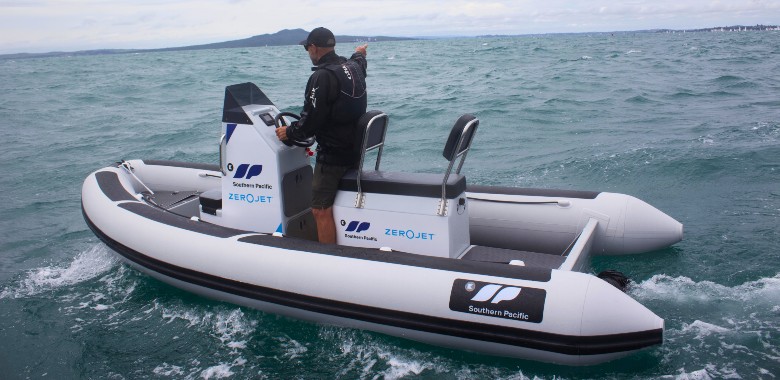
Southern Pacific Boats is also making eco-friendly bounds in the marine industry, especially with the release of their new Cormorant Electric 490. Built upon a 16-degree aluminum hull, the Cormorant Electric has ZeroJet’s 30kW system and 22kWh of high-capacity batteries integrated to ensure equal parts performance and sustainability.
“We are thrilled to partner with Southern Pacific Boats to bring the Cormorant Electric 490 to life,” says ZeroJet’s CEO James Morton. “This project perfectly showcases our 30kW system’s ability to deliver high-performance, commercial-grade power in a lightweight package. In its first day of use at the bay’s regatta, the boat was the first on the water at 8:30am and the last off the water at 4pm. We covered over 20 nautical miles, and we still had plenty of battery to show the boat off at the end of the day. This was great proof that electric boats can do everything clubs and commercial operators need and more.”
Lithium battery systems are also beginning to play a central role in improving marine energy systems.
“Lithium batteries provide a stable voltage curve and allow deeper discharge compared to lead-acid batteries, meaning a significantly higher proportion of store energy is actually usable,” says LiTime’s Marine Application Product Manager, Ikun Liang. “This is critical for both propulsion systems and onboard electronics.”
Liang mentions that weight is also a fundamental performance factor in marine environments. Lithium batteries can deliver equivalent or greater usable energy at significantly lower weight and volume, directly improving vessel efficiency, range and handling.
“In today’s market, electrification is rarely a one-step replacement of primary propulsion,” Liang says. “Instead, it typically begins with specific use cases such as low-speed operation, harbor maneuvering, nearshore short trips, trolling and auxiliary loads. Lithium batteries are particularly well suited for these high-frequency, short-duration and repetitive cycling scenarios. By delivering reliable performance in these applications, they help users build confidence in electric systems, ultimately paving the way for broader adoption of hybrid and fully electric propulsion.”
For example, LiTime’s 24V 100Ah Group 31 Bluetooth lithium battery is designed for 24V trolling motor systems (70–100 lb thrust). It delivers 2560Wh of usable energy within a footprint close to a standard Group 31 battery, while reducing overall volume by approximately 40.8% compared to typical 24V 100Ah lithium batteries.

Rough Waters Ahead for Electric Propulsion
While boat manufacturing has made strides in integrating eco-friendly materials and electric propulsion, several “elephants in the room” remain. As we move through 2026, the industry is shifting from simply making “greener” boats to addressing the entire lifecycle of the vessel.
1. The “Fiberglass Legacy” and Circularity
The most significant hurdle is the lack of a “cradle-to-grave” solution for fiberglass. Unlike aluminum or steel, fiberglass (a thermoset plastic) is notoriously difficult to recycle. Most end-of-life hulls are still ground up for low-value fillers or sent to landfills.
While thermoplastic resins (like Elium) and natural fibers (flax, basalt) are gaining traction because they can be melted down and reused, they are currently more expensive and have different structural properties that require manufacturers to redesign hulls from scratch.
2. The Energy Density Gap
Propulsion remains a physics problem that hasn’t been fully solved for the recreational market. While electric motors are efficient, the energy density of current battery technology still lags far behind gasoline or diesel. For high-performance powerboats or long-range cruisers, the weight of the batteries required to match traditional range often compromises the boat’s performance and safety.
“If you’re looking to replace a high-performance motor with an electric drivetrain, you’re going to need massive batteries, which will significantly impact how to boat performs,” Marine Futures’ Taylor says. “There’s also a high embodied carbon impact with producing those battery cells.”
3. Lack of Charging Infrastructure
Similar to when electric cars first began rolling out, there is very little charging infrastructure available to recreational boaters.
Ben Knowles, a Senior Broker at East Coast Yacht Sales, says the charging infrastructure across the nation is quite terrible.

“It’s very much a friction point right now,” he notes. “Customers have long wait times for charging and the distance that they would normally be able to travel on a gas boat is reduced. So, that’s the big elephant in the room right now when it comes to electrifying boats.”
However, Liang suggests that there is hope for the future, as certain companies are working to develop the charging infrastructure.
“In the United States, industry bodies such as the National Marine Manufacturers Association (NMMA) have identified marina electrification and charging network expansion as key priorities,” Liang says. “Programs are being developed to support the installation of electric and solar-powered charging systems at marinas and public access points.”
In 2022, Tahoe City Marina launched one of the first marine fast-charging stations in the U.S. Meanwhile, Michigan’s Fresh Coast Maritime Challenge has been recognized as the first dedicated gran program in the country to support companies in advancing marina and vessel electrification, with Aqua superpower also deploying fast-charging infrastructure and pilot projects in the region.
4. Maintenance and “Hidden” Pollution
Sustainability doesn’t stop once the boat leaves the factory. New research has highlighted that even “sustainable” hulls can shed microplastics through abrasion against docks or the seabed. Finding hull coatings that are both non-toxic (biocide-free) and durable enough to prevent shedding is a top-tier R&D challenge.
Knowles also suggests that continued maintenance is another challenge with electric boats.
“From the customer’s standpoint, there’s a perceived less maintenance perception with electric boats, but nevertheless, it’s still a boat and it’s going to need service work,” he says. “So, getting the service industry tuned up to the components and the technology that’s needed to troubleshoot the system on the boat can be a setback.”
There’s always going to be trouble with owning a boat, but there’s also always going to be a lot of fun. “We just need the right ratio in order for people to keep coming back and wanting more,” Knowles adds. “If we can’t fix the trouble, then that won’t happen.”
Leading OEMs Driving Momentum
Even though there are fundamental concerns over electric boating, OEMs are actively working to overcome these challenges with the right technology and innovation.
Innovation in the market is being spearheaded by a diverse group of OEMs, each carving out distinct niches based on performance, luxury and use case.
Candela Technology AB in Sweden, for example, is currently working on hydrofoiling electric boats, which is a technology that significantly reduces drag and boosts efficiency by lifting the hull above the water. The company’s C-8 day cruiser exemplifies this, featuring a 69 kWh Polestar battery, achieving 30 knots and offering a 57 nautical mile range.
Candela is also expanding into commercial electric ferries, such as the P-12 Shuttle, demonstrating the scalability of hydrofoil technology for zero-emission water transport.The C-8 Polestar Edition supports DC charging, allowing it to recharge from 10% to 80% in under 30 minutes.
Arc Boats in the U.S. is also focusing on high-performance, fully electric boats with an aerospace-inspired design. The 24-foot Arc One boasts a massive 220 kWh battery, reaching 40 knots with a 50-mile range. The newer 23-foot Arc Sport wake boat packs a 226-kWh battery and a 500-horsepower equivalent electric motor.
Yet another OEM leader is X Shore in Sweden, often dubbed the “Tesla of the Sea,” according to The Marine EV Leadership Series: The Top Companies. The company produces stylish, modular electric “smart boats” for both leisure and professional use.
X Shore models like the Eelex 8000 offer a 126-kWh battery and up to 100 nautical miles range. On the other hand, the more compact X Shore 1 reaches 30 knots with a 50-mile range. These vessels feature modular decks, touchscreen controls and sustainable materials.