
Boating Starts at the Shore: A New Owner’s Guide to Docks and Lifts
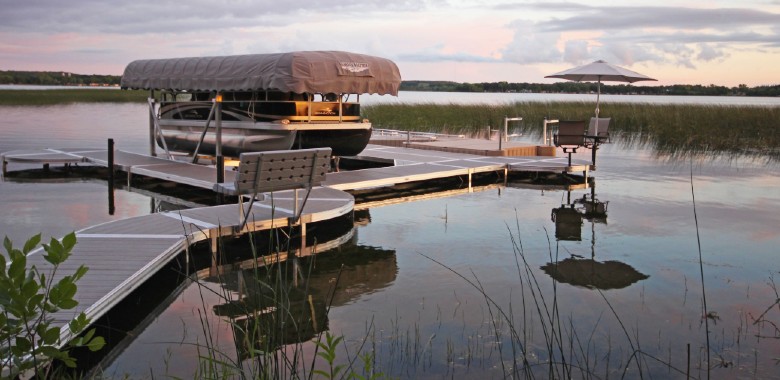
By Ashley Bruggeman
Most new boat owners spend months comparing hull designs, engine specs and onboard features—only to overlook a critical question: where will the boat live? That oversight doesn’t just create inconvenience—it accelerates wear, increases maintenance costs and can ultimately limit how often the boat is used.
Remember, while shopping for a boat is exciting, the dock and lift system ultimately determines how easy, safe and efficient ownership will be. To truly protect the vessel and maximize the experience, owners must view their waterfront as an extension of the boat itself.
The Problem with Wet Storage
While it seems counterintuitive, boats aren’t designed to sit still in the water for extended periods, as this exposes the hull to a range of damaging forces. Within days, algae and biofilm begin clinging to the hull. Left unchecked, this can escalate into heavy fouling that increases drag, reducing both fuel efficiency and top-end speed.
Beneath the surface, prolonged water exposure can also lead to osmosis in fiberglass hulls, allowing water to penetrate the gelcoat and form blisters that compromise structural integrity. Not only does this require expensive repairs, but it’s also a bane to the vessel’s resale value.
There are also less visible risks. Electrolysis, caused by stray electrical currents in the water, can corrode metal components like propellers, shafts and fittings. Meanwhile, boats left tied to a dock remain vulnerable to impact damage from waves, wakes and changing weather conditions—constantly shifting, rubbing and stressing both the vessel and its mooring points.
The Solution
A well-designed dock and lift system addresses these challenges at once. By lifting the boat out of the water when not in use, owners reduce exposure to growth, corrosion and hull damage.
At the same time, a dedicated docking space creates a stable environment for boarding, cleaning and routine maintenance—without the hassle of trailering.
The Modular Evolution
One of the most significant shifts in the marine industry is the move toward modular dock design. Rather than a fixed, one-time installation, modern systems allow owners to build and adapt over time.
Dock sections—straight runs, corners and curves—can be configured to match specific shorelines and boating needs. Owners can start with a simple platform and slip, then expand as needed with additional sections, watercraft ports, seating or storage.
Modern lifts follow a similar path, with adjustable bunks, higher capacities and adaptable components that accommodate different boat types and future upgrades.
The Possibilities
When it comes to waterfront systems, the “where” dictates the “what.” Key environmental factors, such as water depth, bottom composition, shoreline slope, wave activity and seasonal changes, all play a role in determining which system will perform best.
Fixed vs. Floating Docks
Fixed docks, supported by pilings or posts, are ideal for areas with stable water levels and firm lake or seabed conditions. They provide a solid, predictable platform underfoot, making them a popular choice for calm inland lakes or protected waterfronts.
Floating docks, by contrast, rise and fall with the water level. This makes them better suited for environments with fluctuating water levels, such as reservoirs, tidal zones or areas prone to seasonal variation. Additionally, modern floating systems are designed to absorb and dissipate energy from waves and wakes, reducing stress on critical connection points like hinges, couplers and anchoring systems.

Choosing a Boat Lift
Different types of boats have distinct structural and weight-distribution needs, with hull shape, propulsion system and onboard equipment directly affecting the type of lift required to support them safely and effectively. For instance, pontoon boats benefit from wide, evenly spaced bunks to support their dual or tri-tube design, while deep-V hulls require angled bunks that conform to their contours.
Water depth, tidal fluctuations, bottom composition and wave activity also influence the type of lift that will perform best in your environment. For example, areas with shallow or fluctuating water may call for a floating lift, while rougher conditions might require a more robust, four-post configuration for added stability.
Support at Your Fingertips
As expectations for waterfront living have grown, so has the support available to help boat owners bring their vision to life. Today, many manufacturers offer online design tools that allow users to visualize layouts, add accessories and plan their shoreline in 3D.
At the same time, expansive dealer networks provide access to local experts who can recommend a dock system for your unique waterfront needs. Visiting a showroom or working with an authorized waterfront dealer gives new owners the opportunity to see materials up close, understand system options and get guidance tailored to their environment and its local regulations.
The wealth of online resources and comprehensive dealer support has made building the dream waterfront far more accessible, especially for new boaters.
Boating Begins at the Waterfront
Ask any seasoned boater, and they’ll tell you the experience begins long before the engine starts. It begins at the shoreline—where a well-designed dock and lift system doesn’t just store a boat, but transforms how often and how easily it’s used.
Ashley Bruggeman, VP of Marketing and Customer Support at Waterfront Brands, a premium leader of waterfront equipment, including ShoreMaster, HydroHoist, Neptune Boat Lifts, Tide Tamer Waterfront Products, Rhino Marine Systems and PolyDock Products.