2026 Boating Industry forecast

After several years of record demand driven by the Covid-19 pandemic, the recreational boating industry continues to adjust to a new normal. Throughout 2025, new retail sales softened while consumers spent cautiously during uncertain economic times.
But industry leaders remain optimistic as innovation, sustainability and shifting demographics open new opportunities for growth. Boating Industry spoke with industry leaders to learn their perspectives on the challenges influencing today’s market and the opportunities ahead.
“Year-to-date through mid-2025, new powerboat sales were down roughly 10% compared to last year, reflecting a broader trend across other discretionary sectors, like RVs and home improvement,” said Frank Hugelmeyer, president and CEO of NMMA. “The pressure is most evident in entry-level segments, where financing costs have the greatest impact.
“That said, enthusiasm for life on the water remains resilient,” he continued. “Boat usage, club memberships and shared ownership models continue to hold relatively steady, showing that Americans still value the wellness, connection and freedom that boating provides, even if they’re delaying major purchases.”
Market overview
According to a Boating Industry survey, 36.8% of respondents reported that overall revenue was slightly up in 2025 compared to 2024. An equal share of dealers (19.3%) reported revenue was flat or significantly down. Meanwhile, 21.1% of respondents said revenue was slightly down, while just 3.5% reported it was significantly up.

Unit sales were slightly down for the largest share of dealers (29.8%), though 28.1% reported sales were slightly up. Another 21.1% of respondents said unit sales were significantly down, and 17.5% reported flat year-over-year performance.
Looking ahead, dealer sentiment appears positive. Nearly half of respondents (48.1%) expect overall revenue in 2026 to increase slightly, while 9.3% anticipate a significant increase. Another 24.1% expect revenue to remain flat compared to 2025. In contrast, a smaller share of dealers project a downturn, with 11.1% expecting revenue to be slightly down and 7.4% significantly down.
Dealers anticipate the strongest performance in the service department, followed by used boat sales and then new boat sales. Consumer demand remains the top concern, with pricing pressures and compressed margins close behind. Broader economic uncertainty, including the impact of tariffs, ranked as the third-highest concern. Though cited as lower concerns, interest rates, inventory levels, floorplan costs and staffing challenges continue to factor into dealer planning.
“Buyers remain reluctant and dealer inventories are still high, but there’s reason for hope,” said Mark Overbye, CEO of Anthem Marine. “Dealer orders for 2025 were slimmer and aged inventories are closing out, creating opportunities as inventories clear.
“It’s good to remember this is a seasonal and cyclical industry,” he added. “We’ve seen this before. Higher highs and lower lows are characteristic by comparison to other industries. Passion for boating and being on the water hasn’t waned, product sales have. Times like this are a chance to check your enthusiasm for the industry.”
“We’re also seeing a lot of innovation happening across the industry, and that gives us confidence,” said Daniel Sherlock, director of Honda Marine Division. “Companies are adapting, finding creative ways to navigate these challenges, and that innovation is what keeps our overall outlook positive. We’re seeing a lot of resilience and forward-thinking out there, which gives us assurance that the momentum will continue.”
Industry challenges
Opportunities for growth always exist, but the reality is that the market has softened under the weight of mounting challenges. Consumers face high interest rates and financing costs, and dealers and OEMs are navigating affordability, inventory, labor and supply chain challenges, and shifting buyer demographics.
“Our industry depends on both domestic production and globally sourced components, everything from aluminum and copper to engine parts, electronics and raw materials,” Hugelmeyer said. “Overlapping tariffs under Section 232, particularly aluminum and steel, and IEEPA have increased manufacturing costs and complicated sourcing, putting pressure on pricing and long-term planning… Trade policy remains a top priority, particularly as the U.S.-Mexico-Canada agreement is revisited.”

Recent trade agreements have provided some relief, like exemptions for U.S.-manufactured recreational boats from retaliatory tariffs in the European Union. But ongoing disruptions continue to impact production costs and demand.
“This uncertainty makes it difficult for manufacturers, especially small- and mid-sized businesses, to forecast costs, invest confidently and meet growing consumer demand,” Hugelmeyer added. “In the long term, companies are strengthening North American partnerships and exploring ways to improve resilience, but they need predictable and balanced trade policy to maintain global competitiveness, protect U.S. jobs and continue driving innovation across the recreational boating industry.”
Beyond trade and production challenges, the industry faces another fundamental issue – its customer base. The bulk of consumer spending stems from one demographic, and the market needs to be broadened. Boating needs to be accessible and attractive to younger people and more diverse audiences.
“I think it’s a multiyear, multidecade challenge in front of us,” said Keith Yunger, president of Sea Ray Boats and the 2025 Boating Industry Mover and Shaker of the Year. “But if we don’t start chipping away at it, we’re going to wake up a decade from now and ask what happened, [instead of] recognizing new people coming in and learning how to retain them.”
Although the market for higher-end boats is more resilient than other segments today, investing in lower-end, affordable products is important for the long-term health of the industry.
“We’ve got to find more innovative ways to build or keep pricing down so more people can get involved and on the water,” said Jamie Dewar, co-CEO of Legend Boats and a 2025 Boating Industry Mover and Shaker of the Year Finalist. “It’s easy to keep adding and making things bigger and better, but things just escalate and become less affordable. I think there’s an opportunity to get creative, whether it’s with manufacturing techniques, materials or products.”
In 2025, Legend Boats introduced the Pulse, a small, affordable roto-molded utility boat with electric options aimed at helping younger buyers get on the water.
So as dealers see tighter margins and longer sales cycles, manufacturers can help offset these challenges by delivering a balance of innovation and affordability.
Overbye added to this perspective. “Baby boomers are the wealthiest and most passionate boaters. But they’re aging out and they’re less flexible, so their practical needs are different,” he said. “Tapping that market by aligning every dimension of a go to market strategy to keep them happy, as well as their offspring, is a solid move.”
Overbye suggested that recreational boating is transitioning from a sport to a luxury activity, as seen in other industries, and manufacturers and dealers must stay innovative. “Boat prices are extraordinary, on average well past what an average family can afford,” he said. “A former key $399 monthly price has been replaced by $150,000 pontoons and $300,000 surf boats with payments often three times higher than before. Accordingly, the industry is entertaining a higher net worth buyer profile whose expectations are more demanding.”
He said the strongest dealers are transforming their business to attract the high-net-worth buyers who can afford new boats today.
“The smart ones recognize that change is imminent, that yesterday’s pricing models and buyers are being replaced,” he said. “And becoming competitive requires doing more. Becoming savvy with social media, honing sales strategies and overhauling operational tactics are no longer checkboxes on a wish list but must-do items for reaching desired metrics.”
Regulations and policies
Sherlock noted that environmental regulations are evolving quickly, impacting how companies design, build and sell products. NMMA monitors regulations on the federal and state levels, like proposed PFAS bans, emission rules and workplace safety regulations. Hugelmeyer added that increasing regulatory complexity at the state level is stunting industry growth.
The Trump administration, meanwhile, has promoted a business-friendly, anti-regulation sentiment that could ease the regulatory environment at the federal level.

“On the infrastructure front, we are looking at the Water Resources Development Act to continue investments in recreational marine infrastructure, while the reauthorization of the Sport Fish Restoration and Boating Trust Fund, set to expire in 2026, is essential. It provides over $700 million annually for boating infrastructure, conservation and safety programs. NMMA is working with bipartisan congressional champions to ensure this critical user-pay/user-benefit program continues to support access and participation for future generations.”
He readdressed that expanding participation is the greatest opportunity for the industry at this time. Introducing new people to the lifestyle or re-engaging former boaters at every touch point is crucial.
“On the policy front, the passage of the Explore Act, the first-ever stand-alone recreation bill, set an important precedent,” he said. “It opens the door for additional legislation focused on access, recreation infrastructure and conservation, all of which directly support the boating economy. Combined with coordinated industry marketing and advocacy, these opportunities can drive lasting growth.”
Sustainability and innovation
While Honda Marine is focused on adapting quickly and effectively to changing regulations, the company is also dedicated to enhancing boat connectivity and developing technologies that protect boaters and the marine environment.
As a new generation begins to drive sales, many manufacturers are increasingly dedicated to sustainable practices and offering environmentally friendly products.
This focus aligns with broader consumer sentiment. According to a PwC Global Consumer Insights Pulse Survey in February 2023, more than 70% of respondents said they were willing to pay more for sustainably produced goods, showing that demand for eco-friendly innovation is growing across all sectors.
Companies are advancing research into sustainable materials, optimizing manufacturing efficiency, recycling and reducing waste and developing cleaner power solutions. These efforts are a response to evolving standards and regulations, but many of them also reduce costs and increase operational efficiency.
And as products become more efficient, consumers benefit from lower operating costs, enhanced on-water experiences and reduced environmental impact.

Technology also continues to play a major role across every aspect of the industry. Artificial intelligence is emerging as a tool to make boating more efficient, predictive and user-friendly, enhancing both performance and safety on the water.
“We also see potential in improving how connected boats are smarter systems that make operation smoother, safer and more enjoyable,” Sherlock added. “As digital systems become more connected, we’re committed to addressing cybersecurity risks head-on to ensure safety and reliability across the board. Ultimately, it’s all about innovation – finding ways to make boating simpler, safer and more rewarding for everyone.”
Adding to the industry
While manufacturers are improving the overall boating experience through eco-friendly products and technology, Boat Clubs are becoming increasingly popular, making it easier to plan days out on the water. Cecil Cohn, president of Freedom Boat Club, shared that the organization has conducted studies in partnership with Discover Boating and NMMA to learn about boat club members.
“Over 90% of the people joining Freedom or boat clubs in general have no intention of buying a boat when they join the club,” Cohn said. “So it’s truly additive to the industry.”
But he also noted that while about 10% of members leave the boat club every year, anywhere from 10% to 20% of those depart because they plan to purchase their own boat.
Freedom Boat Club has about 60,000 memberships, totaling roughly 100,000 people exposed to the recreational boating industry through the boat club. About one-third of its members are females, and Cohn said a significant number are in their 30s and 40s. “We’re also doing a really good job of retaining older, especially ex-boaters,” he added.
Companies like Suntex Marinas are improving the boating experience and introducing the workforce to careers within the industry.
Bryan Redmond, co-founder and CEO of Suntex and a Boating Industry Mover and Shaker of the Year Finalist, explained the company’s partnership with hospitality schools. Suntex has helped develop a marina operations curriculum, internships and a manager in training program.
“Before we started doing that five or six years ago, I don’t think the majority of students that were going to hospitality school saw marinas as a real career path,” he said. “[Watching] some of the success those young students have had from our organization, who have become leaders within the organization at such a young age, has been a really neat thing to be a part of.”
The company was founded in 2008 with the vision to take the mom-and-pop marina operation and build a scaled platform that treated marinas not just as storage for boats, but as a hospitality experience.
He noted the opportunity for manufacturers, retailers and service providers to work together to improve the customer experience.
“At the end of the day, I don’t feel like we’re competing against other marina operators as much as we are just competing for people’s time,” he said. “Our biggest risk is that somebody decides that the boating lifestyle is just not worth their time anymore.”
To meet this challenge, Suntex offers multiple access points to the water, from rentals and boat clubs to dinner cruises and paddleboards. “The more we do that, the more interest there’s going to be.”
Overbye also emphasized the need for innovative customer experiences to combat the many alternative recreational hobbies. “Attracting and keeping customers should be the highest priority,” he said. “Sometimes novelty and innovation get confused. Changed behavior is innovation, not a new color. Overhauling practices to meet tomorrow’s customers is paramount.”
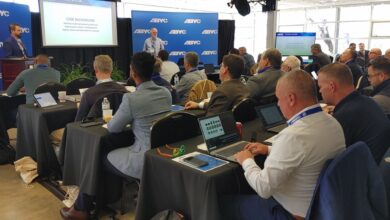
On the workforce front, ABYC is concerned about the effect of the softened market on its educational and certification programs, but so far, enrollment has met expectations.
“Education is putting qualified, certified technicians into the industry at the rate of 60 to 100 per month,” said John Adey, president of ABYC. “Our curriculum is in around 60 schools, and our Accreditation Program is working through applications almost monthly, with 13 already awarded. We are doing as much as we can to get schools to produce techs ready to work. We need industry help to identify and approach schools in areas where talent is needed.
“Larger companies [are] joining ABYC and utilizing benefits like never before,” he added, “[And] we are leveraging this by tailoring programs and offerings that can benefit both small and larger businesses.”
Remaining resilient
“At Honda Marine, our industry outlook is cautiously optimistic,” said Sherlock. “We have our eyes on some short-term headwinds, especially trade dynamics, monetary policy shifts, regulatory pressures and even demographic trends – key issues making the current market adjustment take a bit longer than expected.”
Yamaha is closely watching the effects of tariffs while planning and strategizing to mitigate their impact. Despite these challenges, Mark Tracy, vice president of Yamaha U.S. Marine Business Unit, noted that premium boat sales remain stable, and repower demand continues to be strong – a sign of continued enthusiasm among existing boaters.
Hugelmeyer added that if inflation continues to moderate and interest rates ease, there could be gradual improvement in accessibility and consumer sentiment. In the meantime, NMMA continues to focus on sustaining participation and keeping people engaged through Discover Boating campaigns, boat shows and advocacy for access and innovation.
“Our industry thrives when there’s stability, when businesses can invest confidently and families can plan for the future,” Hugelmeyer said. “That means consistent trade policy, practical science-based regulation, access to affordable financing and sustained investment in public access. Certainty builds confidence and access drives participation.”
“Since the beginning of time, people have loved boats and being on the water,” Overbye concluded. “Boating isn’t going anywhere. Club ownership still makes boating possible for strapped families, but the retail dynamics are evolving. Letting go of expectations and embracing the new norm is the formula for sustained happiness and success.”