Casting Ahead: Key Fishing Boat Trends for 2026
Long before modern navigation tools and composite hulls redefined aquatic travel, fishing boats served as the foundational link between human survival and the open sea. Today, these vessels represent far more than practical tools for harvesting food—they stand at the intersection of a massive global commercial industry and a multi-billion-dollar recreational culture.
Across calm freshwater lakes and unpredictable ocean swells, fishing boats enjoy an enduring, widespread popularity driven by technological innovation, diverse design and the timeless pull of life on the water.
While overall recreational boat sales have declined as of late, NMMA reports that freshwater fishing boats remained relatively flat year-over-year at 54,199 units sold and accounting for 34% of all retail sales through February 2026. Outboard boats have the largest volume, representing 67% of total retail sales with a 6.9% decline on a rolling 12-month basis.
Even though the fishing boat category is still experiencing the negative side effects of a strained economy, they remain the most popular choice for recreational boaters. In fact, according to a fishing study released by the American Sportfishing Association and the Outdoor Foundation, titled “2026 Special Report on Fishing,” sport participation is still above pre-Covid levels.
The study states that in 2025, 57 million Americans ages six and older took to the nation’s waterways for recreational fishing, down slightly from 57.9 million in 2024, but well above the 50.1 million anglers recorded in 2019.
For John Burnham, Marine Specialist and Content Director at Rightboat, fishing boats are one of the most consistently popular categories searched on Rightboat in the U.S.
“Approximately 5,900 boats featured for sale on rightboat.com are categorized as fishing boats (including sport fishing, center consoles, lobster boats etc), or approximately 20% of the inventory,” he says. “Although, in one of our most important regions, Florida, it’s just over 50% of current inventory that falls into this category. Center consoles, bay boats and offshore fishing boats attract a wide range of buyers, and we don’t expect that to change.”
Key Drivers Behind Fishing Boat Growth
The surge in fishing boat popularity is propelled by several distinct economic and lifestyle trends. According to Andy Thompson, President of Brunswick’s Aluminum Boat Group, one of those trends is the different unique applications that can be added to these vessels.
“There are a lot of boats that are becoming unique right down to the applications, such as a duck hunting application, or personalized settings on the boat itself,” he says. “These are the types of features that are more prevalent in the industry.”
Today’s buyers rarely seek a single-purpose vessel. Modern manufacturers have responded by blending hardcore angling features—such as livewells, rod holders and fishfinders—with family amenities like comfortable seating, sun pads and premium audio systems. Center consoles and pontoon boats configured for fishing have seen immense demand because they cater to both serious anglers and casual family outings.
Burnham notes that since anglers are focused on catching fish, any boat designed and equipped for chasing their type of fish is a major draw.
“Buyers look for fishability on deck, range and enough horsepower to get to the fishing grounds quickly and safely,” he says. “Depending on their budget, they’ll be looking for improved speed, control and reliability provided by newer engines, as well as updated electronics. Many buyers will also want more luxury and family-friendly features for day cruising that make the boat multi-purpose.”
The key for OEMs is to offer personalization options so boaters can craft their vessels to their liking.
Technological Accessibility
Advanced marine technology has dramatically lowered the barrier to entry for novice boaters. Integrated GPS, side-scan sonar, electric trolling motors with spot-lock anchoring and joystick steering make navigating waterways and locating fish far less intimidating.
“When you look at the different technologies, such as forward-facing sonar and the ability to spot fish, it makes fishing better, easier and clearer,” says Thompson. “However, it’s expensive. Technology does bring a cost, but from the standpoint of pure fishing, it’s just remarkable how much better the technological solutions have gotten over the past decade.”
Agreeing with Thompson is Burnham, stating that technology plays a big role in boat purchases since consumers like updated electronics, engines, navigation systems and boat controls.
“Boats with fish-finders, radar, autopilot, joystick docking and updated displays will make a difference to many customers on both the purchase decision and resale value,” he says.
An Expanding Demographic
Recreational fishing is no longer restricted to a narrow demographic. Increasing participation among younger adults, women and urban dwellers has expanded the customer base, driving demand for versatile, entry-level boats such as compact aluminum skiffs, modern kayaks and towable fiberglass models.
Brunswick, in particular, is seeing an uptick in younger consumers purchasing fishing boats.
“It’s nice to see that fishing is still considered cool among the younger crowd,” Thompson says. “The age 50 to 59 category is still very strong, but we’re starting to see the demand shift, like the age 40 to 49 and 30 to 39 categories. It’s been more prominent within the last two years.”
For Rightboat, fishing boat buyers range from serious anglers to families who want one boat they can use to fish, cruise and do watersports.
“Larger and more heavily equipped boats tend to attract experienced buyers with more boating know-how and spending power,” Burnham explains. “Men remain the overwhelming majority of fishing boat owners. Women accounted for 25% of identifiable U.S. visitors searching through Rightboat in 2024, up from 13% in 2017.”
According to the “2026 Special Report on Fishing,” women made up 38% of participants in fishing in 2025. Female participation dipped slightly in 2025, falling from 21.3 million in 2024 to 21.1 million in 2025.
Despite this modest decline, the report states that long-term trajectory remains strong, as female anglers grew by 5.4 million over the past decade, from 15.7 million in 2015 to 21.1 million in 2025, a 34% increase. In 2025, females represented 37% of total anglers, 41% of first-time participants and 43% of those considering fishing.
Electrification and Sustainability
Sustainability has been a big innovation-driver for OEMs, with consumers driving the desire for more eco-friendly boating options. Creating new electric fleets is very much front of mind for Brunswick.
“When you look at precious metals and where consumers are coming from in a geopolitical point of view, there are a lot of sensitivities to the sustainable element which continue to ramp up over time,” Thompson notes.
The consumers that seem most interested in electric fishing boats are those out on lakes, especially since many state parks, local municipalities and drinking-water reservoirs explicitly require electric-only motors and ban all gasoline-powered combustion engines.
“The largest generation of electrification is in the restricted lakes where you need to have an electric motor in order to be on the water,” Thompson explains.
Burnham is seeing a slight uptick with electric outboards, stating that “anglers have long used electric trolling motors, and electric outboards on skiffs and small aluminum fishing boats are gaining some traction.”
The larger fishing market has yet to fully turn to electric power, although brands like Scout offer smaller center console models with electric power.
According to Thompson, one of the biggest challenges the electric boat category faces is getting consumers over that conversion point.
“I liken it to Tesla back in the day, when it was still a novelty and wasn’t mainstream,” he says. “Now, electric cars are everywhere. I think there’s still a market for electric boats, but it’s similar to the automotive industry and just has a delayed conversion.”
From an application point of view, the technology is certainly up to par, but battery life is still lacking, which matters when you’re out on the water fishing for hours at a time. With time, the industry will continue to innovate, and electric boats may very well catch up to the electric cars industry.
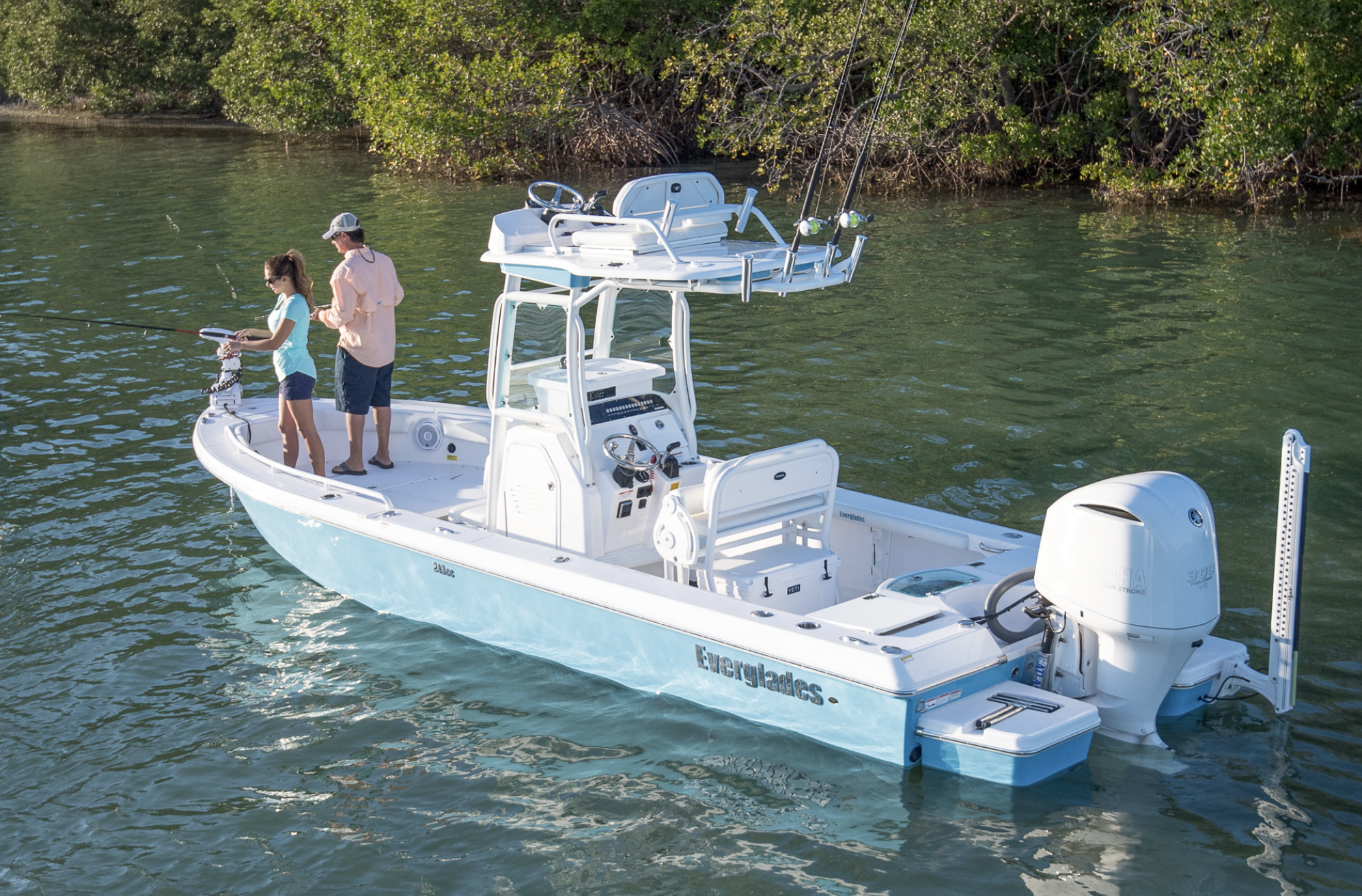
A Bright Future for Fishing Boats
Looking ahead, Burnham predicts the market will remain strong due to the enduring impulse to find and catch fish.
“In recent years, manufacturers have responded to the demand to make fish-focused more versatile, appealing to both anglers and families,” he says. “All this will be supported by more efficient outboards, better electronics, smarter controls and greater comfort.”
“Fishing is great because it’s something you can do with your family, it doesn’t take a tremendous amount of skill to do and it’s an awesome experience,” Thompson adds. “There’s so many quality products that Brunswick makes that allow you to do everything on the water.”
Boat club memberships and rental options like Freedom Boat Club are also becoming more popular and making it easier for more people to access the water.
The fishing boat segment is evolving in two directions – upmarket with bigger, more tech-heavy boats and inland with aluminum models. Across both, technology, versatility and sustainability are shaping the future. Manufacturers are responding with smarter systems, hybrid layouts and efforts to keep boating accessible and sustainable.
This article was originally featured in the September 2026 edition of Boating Industry.